Community
How To Create An Effective Study Methodology for Large Exams
l
CS
By Claire S on February 22, 2026

Semester and end-of-year exams can be daunting. There is so much information you have to remember and be able to apply to problems. The score you receive also often determines if you pass or fail the class. Thus, it is imperative to design an effective study schedule that will make sure you review all the vital concepts for your class to give you the best chance of succeeding on your exams. For instance, there are many study techniques, such as Pomodoro, flashcards, and more! These study techniques have different results for different people, so explore your options to find the one that works best for you.
STEM Classes:
For science, math, and engineering type classes, practice exams and practice problems from your professor/teacher are going to be your best friends. However, flashcards and re-reading the textbook are not a good use of your time, as the application of the concepts is what will be on your exam, not dictionary definitions. Exams will not typically go over surface-level questions; they will go more in-depth as you have been studying these topics all year/semester. You should have also already read your textbook throughout the semester and been practicing the basic skills required. On an aside, you can definitely use flashcards at the beginning of the semester to learn various terms/vocabulary related to your class, but by the time the final is rolling around, you should already know them.
You will want to space out your studying over the course of around 2 weeks before your exam and study in 30 minute-1 hour increments before a short break. Breaks are important as they allow your brain to reset and not get fatigued. One time management method is the Pomodoro technique, which follows the study-break-study routine. However, it is up to your current knowledge of the class and focusing abilities to choose how long you study before you take a break. If you are more comfortable with the content and have done well on your previous midterms/tests in the class, you can spend less time studying for the final. On the contrary, if you have struggled with previous material in the class, then you would want to study more. However, everyone’s will look different, so don’t compare study schedules. An example schedule could look like the following:
Class Name: Calculus 2
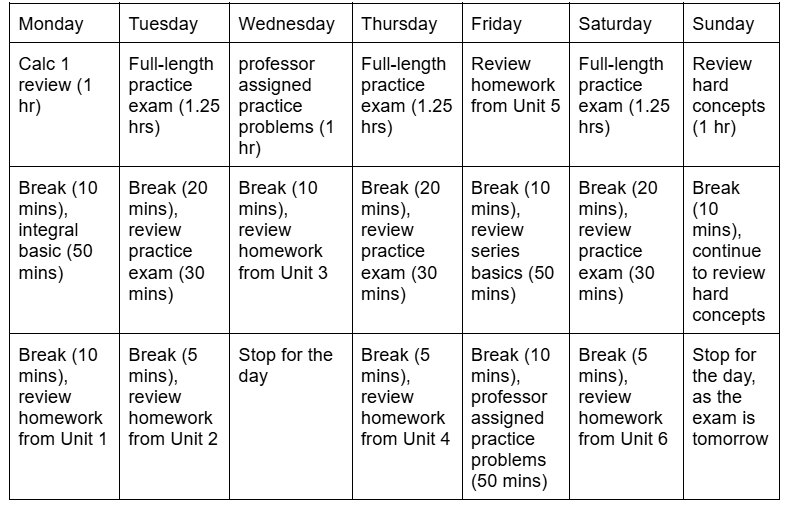
This example is of a schedule for a Calculus class, but can be generalized to any STEM class. The student starts to study for the exam 2 weeks before it is scheduled. Each day, they did around 3 hours of studying, as they know they lose focus after 3 hours. In reality, you won’t be studying for one exam; you will be studying for numerous exams at the same time. Therefore, it is not realistic to be able to dedicate 10 hours a day to one exam, with other exams. You'll be studying for numerous exams at the same time. In addition, you will also have other things to do, such as classes, work, and various commitments. Therefore, it is not realistic to dedicate enormous amounts of time each day to studying for a single exam. The student makes sure to include breaks in their study plan, and to do lots of practice problems/ old exams to become familiar with the professor's style of writing. They check their answers and identify both weaknesses to study harder and topics they know well and may not need to explicitly study.
Your study plan will be unique, as your knowledge is unique. Don’t compare your plan to others, as what works for you may not work for them. For STEM classes, the two largest tips for success are to space out your studying and to do practice problems written by the same person who will write your exams to become familiar with their question style.
Humanities Classes:
Humanities classes are very different from STEM classes in their structure and expectations. The humanities and sciences are difficult in different ways. Although the humanities allow room for subjective interpretation and often have no rigid correct answer, it is still important to dedicate time to prepare for your humanities finals. You still need to dedicate time to preparing for your finals. The type of final may differ as some classes may have a final essay, project, or exam. For all you still need to start early. For project-based classes such as art or music, you need to start at least a month in advance to have adequate time to prepare your pieces. For essay-based exams, starting 3-4 weeks in advance will give you adequate time to research, write, revise, and potentially start the process again.
For exam-based classes that could include history, philosophy, ethics, etc. You will want to set a schedule like the STEM example I provided earlier. However, you will need to use different means of studying. If your professor provides practice problems, definitely do them as they are great resources to learn what to expect. For example, Flashcards are a great asset to exams that focus on rote memorization of content. It is best to make the flashcards as you go along with your class, as you may have quizzes and midterms, which you could also use the flashcards to study for. Making them periodically also alleviates the stress of trying to make them all at once right before your exam. You can choose the form of flashcards that works best for you, like paper-based or online. An example schedule could look like the following:
Class Name: American History
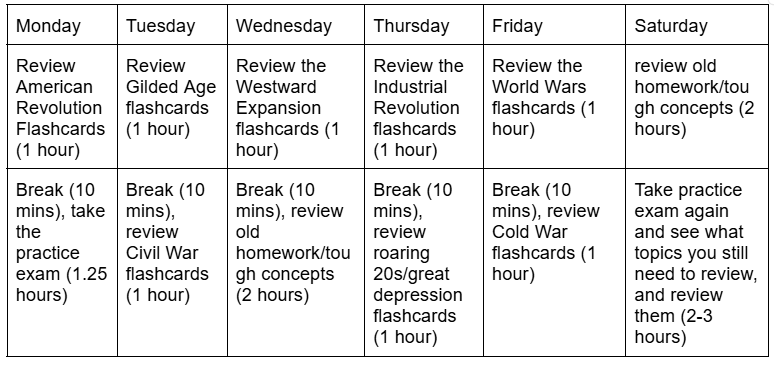
In this example, the student is taking a class where memorizing facts will earn them a high score, so they spend most of their time using flashcards to memorize the important concepts their professor and/or textbook mentions. The professor also gave them a practice exam, but only one, so they took it both at the beginning and at the end of the week to evaluate their progress and know what areas they need to focus on more.
Conclusion:
To prepare for finals/end-of-year exams, a few things remain the same for all classes, such as preparing early so you don’t have to cram and taking breaks to keep yourself from excessive fatigue. Other important aspects to scoring well relate to your health, such as getting good sleep and eating well to rest and fuel your brain effectively, so it can function optimally. The differences lie within the method of studying, which will change based on the exam structure and what works best for your learning style. As you take more large exams, you will find what works best for you. By following a schedule and making a study plan, you will have less stress and be able to perform better on the exam.
Thank you to Jasmine G. for editing this article!