Introduction
DNA stands for deoxyribonucleic acid. It constitutes our genetics, contains information for protein synthesis, and is essential for the continuation of life. In this article, I will review the functions of DNA, go over the history of DNA briefly, and discuss its structure.
What makes up DNA?
The shape of DNA is referred to as the “double helix.” It is made up of nitrogenous bases, often referred to as ladder rungs, and a backbone that keeps the bases together.
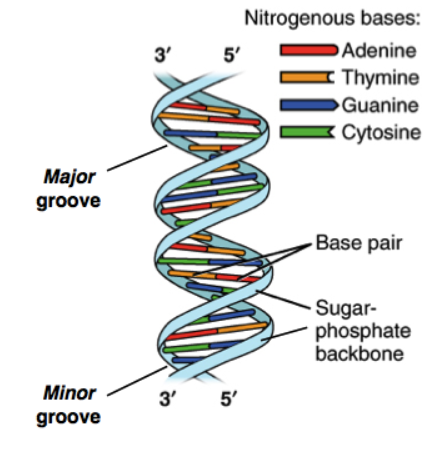
(credit to Khan Academy)
The nitrogenous bases that were previously mentioned include Adenine, Thymine, Guanine, and Cytosine. Adenine and Thymine work together as a pair, connecting each of their rungs together with 2 hydrogen bonds. Guanine and Cytosine operate the same way, the only exception being that they have 3 hydrogen bonds holding them together. Adenine and Guanine are referred to as Purines, meaning that they are larger and have two nitrogen rings. Meanwhile, Cytosine and Thymine are smaller and only have one ring. These rings are essential for the structure and formation of nucleic acids (like DNA and RNA).
The backbone of the DNA structure is made up of phosphate and sugar. Keeping the backbone attached to the nitrogenous bases, covalent bonds play a key role in maintaining the shape and function of DNA. If you group one base, one group of phosphate, and one unit of 5-carbon sugar, then you have what is called a nucleotide. These smaller units come together to make the larger structure.
What are the functions of DNA?
DNA’s main function is to store genetic information, which helps define who we are in terms of the characteristics we express (genetic expression) physically and mentally. It is found in the chromosomes, which humans have 23 of. 22 of these chromosomes are all the same, but the 23rd chromosome determines your biological gender.
The second function of DNA is to store information for protein synthesis. This helps provide the code that the amino acids use to assemble into proteins. This is done through a lengthy process called DNA replication, which I won’t cover here but is very necessary for keeping us alive and making sure we have the proteins needed to survive.
DNA History
In 1928, a medical doctor named Griffith discovered that there was a transforming factor. Years later, scientists named Avery, Maceloid, and McCarthy furthered this research and destroyed proteins, lipids, carbohydrates, and RNA one at a time to see if transformation occurred. They found that DNA was the transforming factor because it holds the hereditary information and can permanently change the characteristics of the organism.
In 1950, Hershey and Chase worked with bacterial phages (eaters). Their tests with these phages led them to discover that genetic information is in DNA, and not proteins, as was previously thought.
In 1952, Rosalind Franklin worked with X-rays and crystallography to get the best image of DNA. This image and her research helped Watson, Crick, and Wilkins, who found out DNA’s structure in 1953. These three men were able to get Nobel prizes for their work, but sadly, Franklin passed away before she could be recognized at all.
Some extra information is that in 2000, they figured out the genome. And Chargoff discovered the nitrogenous base pairs of DNA.
Thank you to Geetha S. for editing this article!